
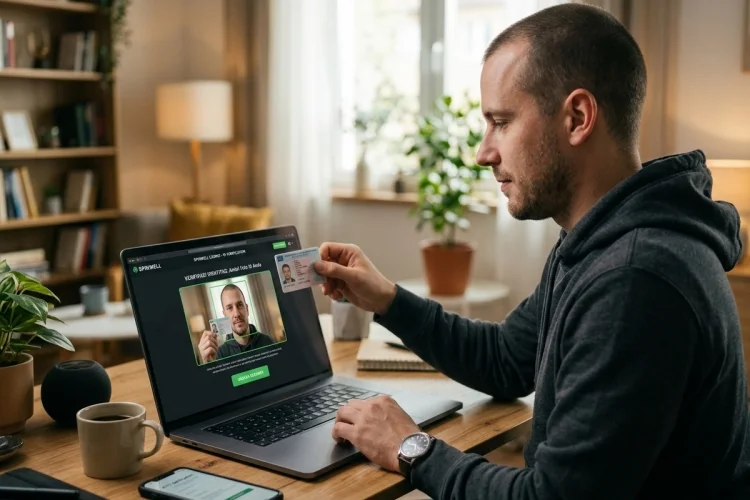
You verify your name and address when opening an account, start playing, and assume the verification process is finished. Months later, the operator asks for another document or information about where certain deposits came from. Why?
The answer becomes clearer once you understand What Is KYC in Online Gambling? Basic identity verification is only one layer of customer due diligence.
Regulated operators may also have anti-money-laundering obligations, ongoing monitoring requirements, and risk-based checks. Understanding the difference between KYC, Source of Funds, and withdrawal verification helps make these requests less confusing.
KYC Starts With Knowing Who Owns the Account
At its simplest, KYC establishes the identity behind an online account.
An operator needs reasonable confidence that the customer exists and that key registration details belong to the same person.
In Great Britain, current remote-gambling rules require operators to verify at least the customer’s name, address, and date of birth before allowing gambling.
This helps reduce risks such as underage gambling and identity fraud.
It can also help operators recognize customers who are subject to self-exclusion controls.
The same principle is reflected internationally in FATF customer-due-diligence standards, which require casinos within scope to identify and verify customers under applicable conditions.
The precise legal trigger and method can differ from one country to another.
Basic KYC and Enhanced Due Diligence Are Different
Not every customer receives the same level of scrutiny.
Basic KYC may involve confirming personal details and an identity document.
Enhanced Due Diligence, often shortened to EDD, goes further when customer or transaction risk is higher.
UK Gambling Commission AML guidance describes a risk-based approach in which higher-risk relationships require more information, stronger checks, and enhanced ongoing monitoring.
That could involve understanding why particular transactions occurred, examining financial patterns, or gathering information about the origin of money.
This distinction explains why somebody can successfully complete basic KYC and still receive another compliance request later.
The second request may be answering a different question entirely.
What Is Source of Funds?
Source of Funds, commonly abbreviated SOF, asks where the money used for a particular gambling relationship or transaction came from.
That could involve salary, business income, savings, an investment sale, an inheritance, or another legitimate source.
The Gambling Commission defines Source of Funds as where the money financing a transaction comes from.
Depending on circumstances, evidence could include bank statements, payslips, tax documents, business records, or documentation supporting another source.
Not every player should assume they will automatically be asked for every one of these documents.
The level of checking should depend on legal requirements, account risk, transaction patterns, and the operator’s compliance procedures.
The UK’s 2026 remote-casino risk assessment specifically highlights inadequate scrutiny of source-of-funds documents as a money-laundering risk.
Source of Funds vs Source of Wealth
These phrases sound similar but answer different questions.
Source of Funds looks at the origin of money being used.
Source of Wealth looks at how a person’s overall wealth or assets were accumulated.
The Gambling Commission defines Source of Wealth as the origin of an individual’s overall body of wealth and how that wealth was acquired.
For example, a customer’s immediate deposit might come from a bank account—this alone does not explain the original source of the money.
A more detailed check could therefore ask whether the underlying wealth came from employment income, company ownership, investments, property, or another source.
Enhanced checks are generally associated with higher-risk circumstances rather than being identical for every customer.
Understanding this seperation helps explain why simply showing that money came from a bank account may not always answer a compliance question.
Why Do Gambling Operators Care About Money Laundering?
Online gambling accounts can potentially be misused to move or disguise illicit funds.
Someone could attempt to deposit money from questionable sources, perform minimal gambling activity, and then withdraw funds in a way intended to make them appear legitimate.
Other risks include third-party payment methods, mule accounts, fake identities, stolen accounts, and coordinated transactions.
The UK Gambling Commission’s July 2026 remote-casino assessment lists third-party use, mule accounts, suspicious payment behaviour, fraudulent documentation, high-risk payment methods, and inadequate customer monitoring among current sector risks.
FATF guidance similarly treats casinos as a sector that requires customer due diligence and transaction-linked controls because of money-laundering risks.
KYC therefore protects more than account access. It is also one element of the financial-crime control framework.
Why Can KYC Be Repeated?
Customer risk is not fixed forever.
An account that originally appears low risk can later display new activity requiring closer examination.
The operator may also need to update outdated personal information.
UK rules require remote licensees to take reasonable steps to keep identity information accurate.
AML guidance also expects ongoing monitoring and the ability to adjust risk ratings when customer behaviour changes.
For example, a large and unusual increase in deposits may generate different questions from a small, consistent pattern of activity.
That does not mean every increase automatically indicates wrongdoing.
It means regulated businesses can be required to investigate situations that meet their risk criteria rather than treating the initial identity check as permanent proof that all future activity is low risk.
What Happens When You Request a Withdrawal?
Withdrawal is one of the most misunderstood parts of KYC.
Customers sometimes encounter verification only when trying to cash out, creating the impression that identity checks are intentionally used to delay payment.
Under Great Britain rules, operators should not demand information at withdrawal that they could reasonably have requested earlier.
The regulator reiterated this principle in August 2026, warning that failing to conduct basic verification early enough creates disruption and consumer frustration.
However, additional AML checks can still be legitimate if a legal obligation or new risk arises later.
For instance, suspicious financial activity might require information that was not reasonably necessary when the account was initially created.
The difference lies in whether the request is genuinely new and required or was simply delayed without justification.
Can Operators Use Facial Verification?
Some digital identity systems can use facial recognition or biometric matching.
A typical process may compare a live selfie or video image with the photograph on an official identity document.
The UK’s ICO explains that facial verification can create biometric templates and compare them to determine whether the person presenting an ID appears to be the same individual shown in the document.
This is more sensitive than a simple name check.
Biometric recognition processes personal information, and biometric data used for unique identification can receive additional legal protections.
Operators and their verification providers therefore have data-protection responsiblities in addition to gambling-compliance obligations.
Players should also make sure biometric requests appear through genuine operator channels before uploading anything.
Is KYC Information Safe to Upload?
Identity verification necessarily involves personal data, so security and privacy deserve attention.
Use only the official operator website, mobile application, or secure verification portal identified by the operator.
Do not send passport photographs or bank documents to unknown Telegram users, unofficial social-media accounts, or anyone claiming they can bypass verification.
The UK Gambling Commission warns customers not to let other people use their identity details for gambling accounts because third-party account creation can facilitate fraud, criminal activity, bonus abuse, and attempts to bypass responsible-gambling restrictions.
Where biometric technology is used, the ICO states that data-protection obligations apply because the technology processes personal information.
A legitimate verification request can still involve sensitive information, which is exactly why confirming the destination matters.
KYC Rules Are Not Identical Worldwide
Online gambling regulation is jurisdiction-specific.
Great Britain’s rules provide useful examples, but they should not be described as universal requirements for every licensed market.
International FATF standards establish broad anti-money-laundering expectations, but individual countries implement them through national laws and regulatory frameworks.
One jurisdiction may require identity checks before gambling, while another may use different timing, thresholds, accepted documents, or verification technologies.
Operators can also apply risk-based controls within those legal frameworks.
When checking a casino’s KYC policy, identify which regulator licenses the service and read the rules applicable to your specific location.
Do not rely on an old article describing another country’s system as though it applies everywhere.
KYC in online gambling goes beyond checking a passport. Basic identity verification confirms who owns the account, while AML controls can lead to Source of Funds, Source of Wealth, or enhanced checks when risk increases.
Use accurate registration information and official verification channels. If additional documents are requested, understand what type of check is being performed and why rather than assuming every request is the same.