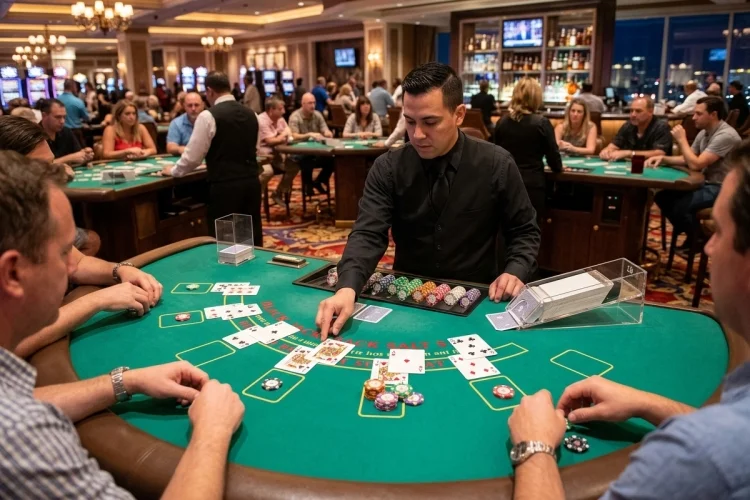
Blackjack has its own vocabulary, but it is not as complicated as it sounds. Words such as “shoe,” “natural,” “soft total,” and “push” describe ordinary parts of the game.
Once you know them, dealer instructions and rule notices become much easier to understand. This casual glossary explains Blackjack Rules by grouping important terms according to how they are used at the table.
Instead of memorizing a huge alphabetical list, you will learn the language of hand values, player decisions, dealer actions, equipment, and payouts.
The explanations also highlight rule variations that beginners should check because the same action may be available at one table and restricted at another.
Essential Number and Hand Terms
A hand total is the combined value of the cards you hold. Cards numbered 2 through 9 use their printed values, while tens and face cards count as 10. An ace can count as 1 or 11.
A natural or blackjack is an ace and a ten-value card dealt as the initial two cards. A bust occurs when a total exceeds 21.
A hard total contains no flexible ace. A soft total includes an ace currently valued as 11. Soft hands are flexible because the ace can drop to 1 when necessary.
Basic Action Language
1. Hit, Stand, and Bust
Hit means requesting another card. Players may continue hitting while the hand remains below 22 and the rules allow another draw.
Stand means keeping the current total and ending the turn. If a hit produces a total above 21, the hand is busted, sometimes also described as “breaking.” The wager is settled immediately rather than waiting for the dealer’s final total.
2. Double Down and Split
To double down, a player increases the original bet by an equal amount and receives one final card. The hand automatically stands afterward.
To split means separating two matching or equally valued starting cards into individual hands. A second wager is added, and the hands are completed separately. Rules involving resplitting, split aces, and doubling after a split can differ between games.
Special-Bet and Exit Terms
Insurance is an optional side bet offered when the dealer’s upcard is an ace. It may generally be worth up to half of the main wager and pays 2:1 when the hole card gives the dealer blackjack. The insurance wager is settled separately from the player’s original hand.
Even money may be offered when a player has natural blackjack and the dealer shows an ace. Accepting it settles the hand at a 1:1 profit instead of waiting to see whether the dealer also has blackjack.
Surrender means abandoning the opening hand and recovering part of the stake, usually half. Some games offer late surrender, some use different timing, and many do not offer the option at all.
Dealer and Card Terms
The dealer’s visible card is the upcard, while the hidden second card is the hole card. If the upcard is an ace or a ten-value card, certain games allow the dealer to check the hole card for blackjack before players continue.
A dealer draws or hits when another card is required. The phrases H17 and S17 refer to whether the dealer hits or stands on soft 17.
A dealer bust helps only players who have not already exceeded 21. Once a player busts, the wager is lost even when the dealer later goes over the limit.
Table Equipment Terms
The layout is the felt or material covering the table. It contains marked betting areas and printed information about payouts or dealer rules.
A shoe is a device that holds two or more decks and releases cards one at a time. A cut card is a colored plastic card inserted into the stack. When it appears during dealing, it signals that the current shoe is approaching its reshuffle point.
A burn card is removed from the top of a deck or shoe and placed in the discard area. Burning may take place when a fresh shoe begins or when table procedures require it.
Results and Payout Language
A regular winning wager is commonly paid even money, or 1:1. A $20 bet therefore earns $20 in profit.
A push is a tie between the player and dealer. The original wager is returned without profit or loss. A natural blackjack may pay 3:2, 6:5, or another clearly posted amount depending on the game.
The house edge is the casino’s long-term mathematical advantage under a particular combination of rules. It does not predict the outcome of a single round, and even a statistically appropriate decision can lose.
Table Etiquette and Safe Limits
At a physical table, use hand signals rather than relying only on spoken instructions. Do not move the main wager after cards have been dealt, and let the dealer handle the cards unless the game format specifically allows players to touch them.
Check the table limit before joining and decide how much time and money you are willing to spend. Responsible-play guidance recommends treating gambling as entertainment, avoiding borrowed money, and leaving when a predetermined limit is reached.
The language surrounding Blackjack Rules is mainly a collection of useful shortcuts. Hit means take a card, stand means stop, a natural is an opening two-card 21, a push is a tie, and the hole card is the dealer’s hidden card.
Terms such as H17, surrender, and blackjack payout describe conditions that may change between tables. Review this glossary before your first session and keep it nearby while practicing with free-play games.
Always check the posted rules rather than assuming every version is identical. Set strict spending and time limits, play only where participation is legal and age-appropriate, and keep the game focused on affordable entertainment.